Markov and Chebyshev
How likely is a bad answer?
2026-11-16
Tail Bounds
Let X be a random estimate of a target \mu.
\underbrace{\Pr(|X-\mu|\geq\varepsilon)}_{\text{probability of a bad answer}}
\leq
\underbrace{\delta}_{\text{allowed failure probability}}.
- \varepsilon measures the size of the error.
- \delta measures how often we allow that error.
Markov’s inequality
Suppose X\geq0 and \mathbb E[X]<\infty. For every t>0,
\boxed{\Pr(X\geq t)\leq\frac{\mathbb E[X]}{t}.}
Indicator random variables
For an event A, the indicator of A is the random variable
\mathbf 1_A=\begin{cases}
1 & \text{if } A \text{ occurs},\\
0 & \text{otherwise}.
\end{cases}
Its expectation is the probability of the event:
\boxed{\mathbb E[\mathbf 1_A]=\Pr(A).}
You will prove this in the homework.
Markov’s inequality: Proof
Take the bad event A=\{X\geq t\}, so \mathbf 1_{\{X\geq t\}} is 1 when X\geq t and 0 otherwise. We claim
X\geq t\,\mathbf 1_{\{X\geq t\}}.
- If X\geq t, the right side is t, and X\geq t holds.
- If X<t, the right side is 0, and X\geq0 holds.
Take expectations, then divide by t:
\mathbb E[X]
\geq t\,\mathbb E[\mathbf 1_{\{X\geq t\}}]
=t\,\Pr(X\geq t).
Markov is tight
Fix t>0 and 0<p\leq1. Let
X=\begin{cases}
t & \text{with probability }p,\\
0 & \text{with probability }1-p.
\end{cases}
\mathbb E[X]=tp,
\qquad
\Pr(X\geq t)=p=\frac{\mathbb E[X]}{t}.
A stronger general guarantee needs more information.
Yes, tight, but usually loose
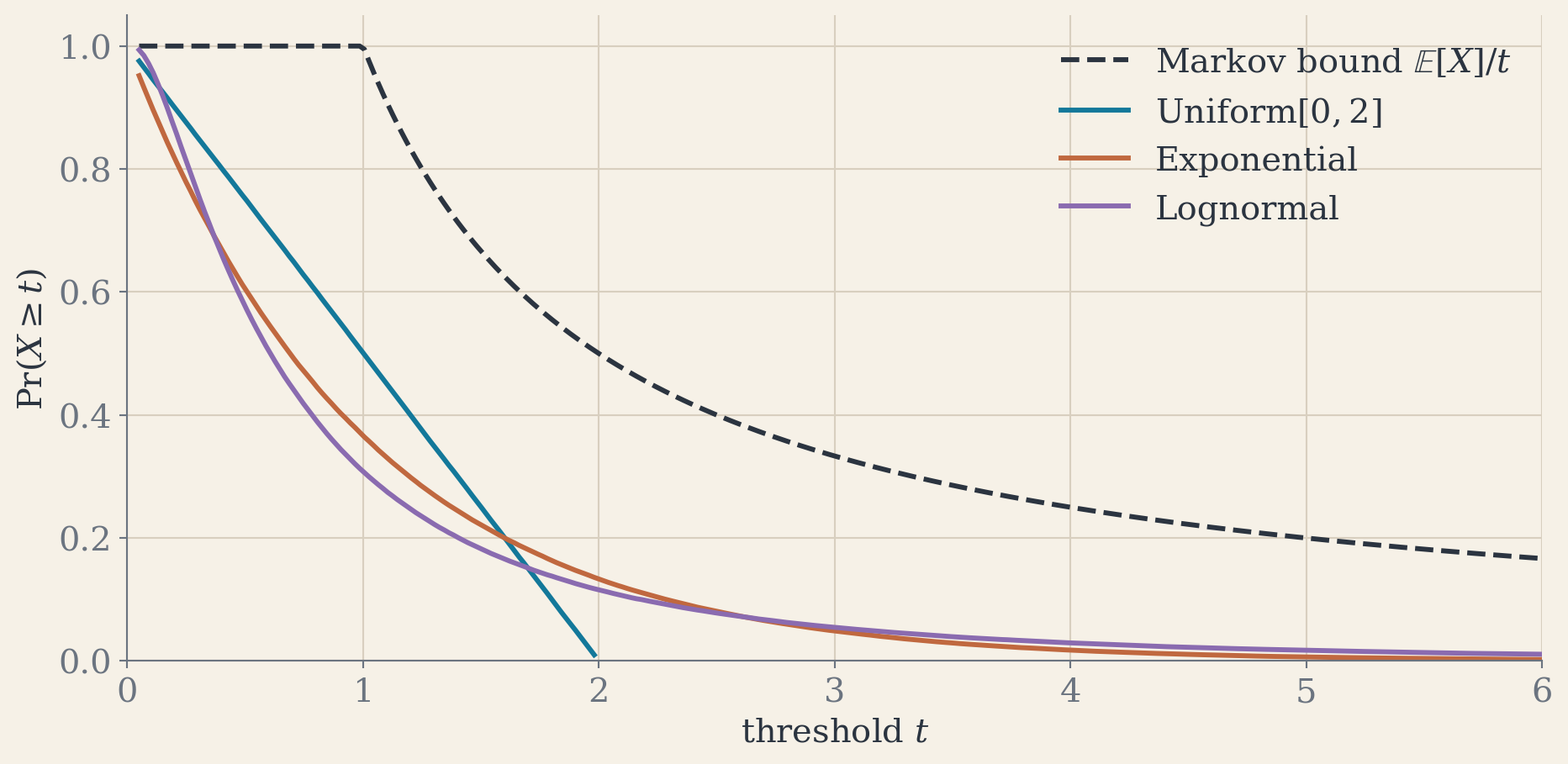
Three nonnegative distributions, each with \mathbb E[X]=1, sampled 200{,}000 times.
The bound always holds, but it ignores the shape of the distribution.
Pause: a better bound
Suppose \mathbb E[X]=\mu and \operatorname{Var}(X)=\sigma^2.
We want to bound \Pr(|X-\mu|\geq t).
Which other nonnegative random variable could we put into Markov’s inequality?
Square the deviation
Use the nonnegative random variable
Y=(X-\mu)^2,
\qquad
\mathbb E[Y]=\sigma^2,
with threshold t^2.
The bad event does not change:
\{|X-\mu|\geq t\}=\{Y\geq t^2\}.
Chebyshev’s inequality
If X has mean \mu and finite variance \sigma^2, then for t>0,
\boxed{\Pr(|X-\mu|\geq t)\leq\frac{\sigma^2}{t^2}.}
\begin{aligned}
\Pr(|X-\mu|\geq t)
&=\Pr\big((X-\mu)^2\geq t^2\big)\\
&\leq\frac{\mathbb E[(X-\mu)^2]}{t^2}
=\frac{\sigma^2}{t^2}.
\end{aligned}
Distances measured in standard deviations
For \sigma>0, set t=c\sigma. Then
\Pr(|X-\mu|\geq c\sigma)\leq\frac1{c^2}.
This holds for every distribution with finite variance.
Chebyshev in simulation
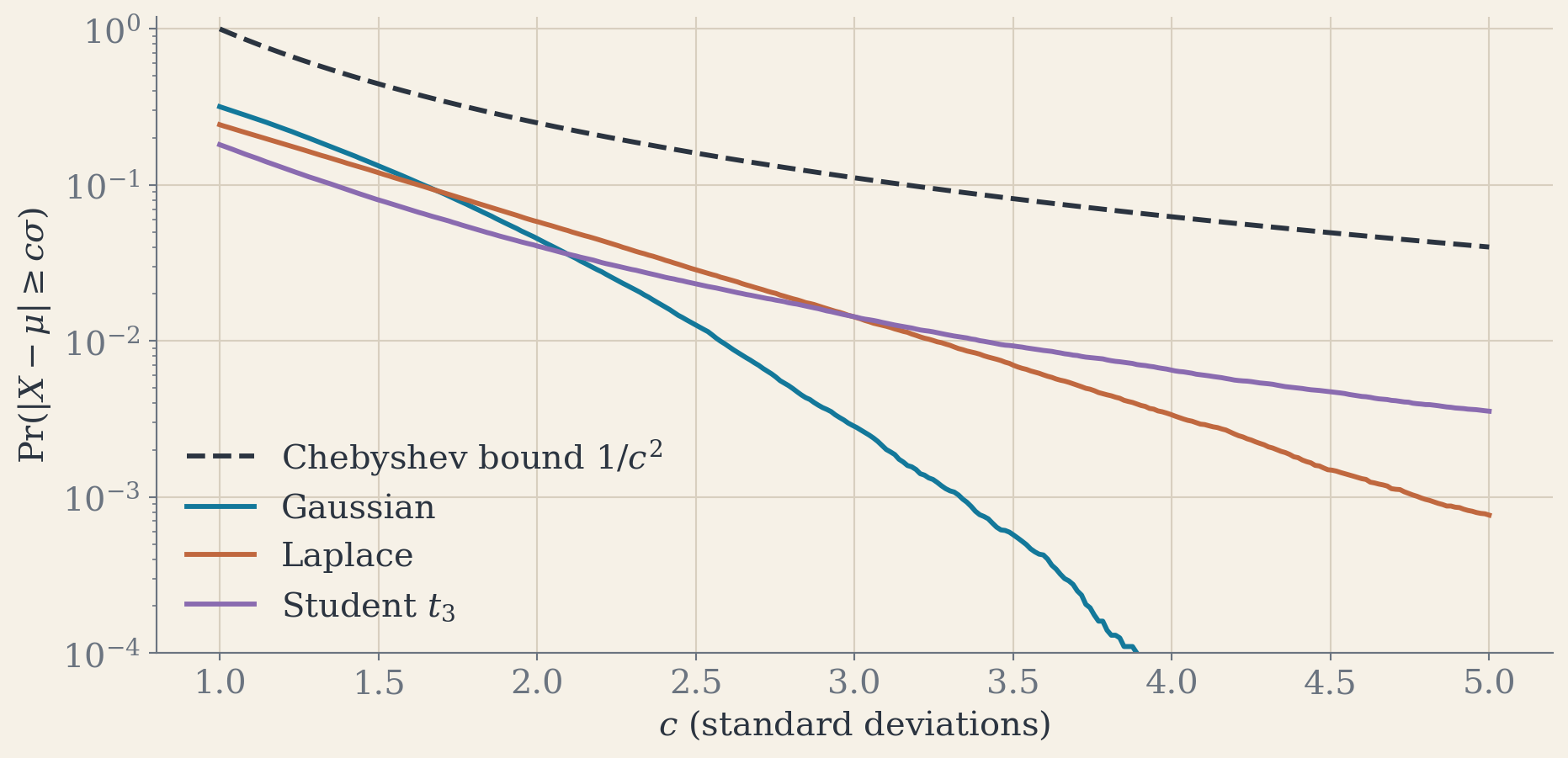
Three distributions standardized to \mu=0, \sigma=1. Note the log scale.
Heavy tails come closest to the bound. The Gaussian falls off much faster.
Averaging reduces the variance
Let X_1,\ldots,X_m be independent with common mean \mu and variance \sigma^2, and \overline X=\frac1m\sum_{i=1}^m X_i.
\begin{aligned}
\operatorname{Var}(\overline X)
&=\frac1{m^2}\operatorname{Var}\Big(\sum_{i=1}^m X_i\Big)\\
&=\frac1{m^2}\sum_{i=1}^m\operatorname{Var}(X_i)
=\frac{\sigma^2}{m}.
\end{aligned}
Since \mathbb E[\overline X]=\mu, Chebyshev with t=\varepsilon gives
\boxed{\Pr(|\overline X-\mu|\geq\varepsilon)
\leq\frac{\sigma^2}{m\varepsilon^2}.}
Averages concentrate
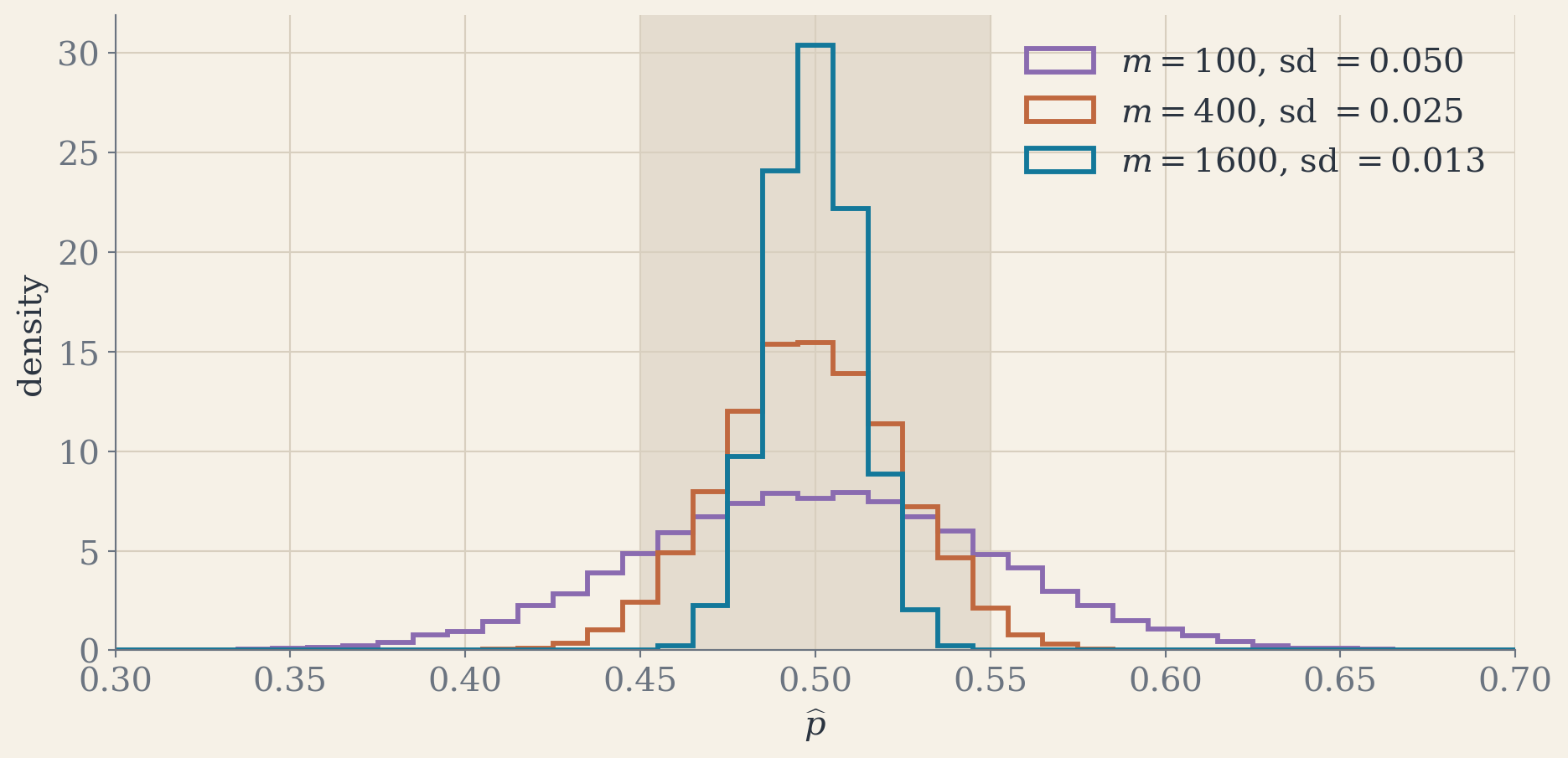
Simulated \widehat p for fair coin flips (p=1/2), 20{,}000 repetitions each. The shaded band is |\widehat p-p|<0.05.
Each fourfold increase in m halves the spread: \operatorname{sd}(\widehat p)=\sigma/\sqrt m.
Chebyshev is safe, but pessimistic
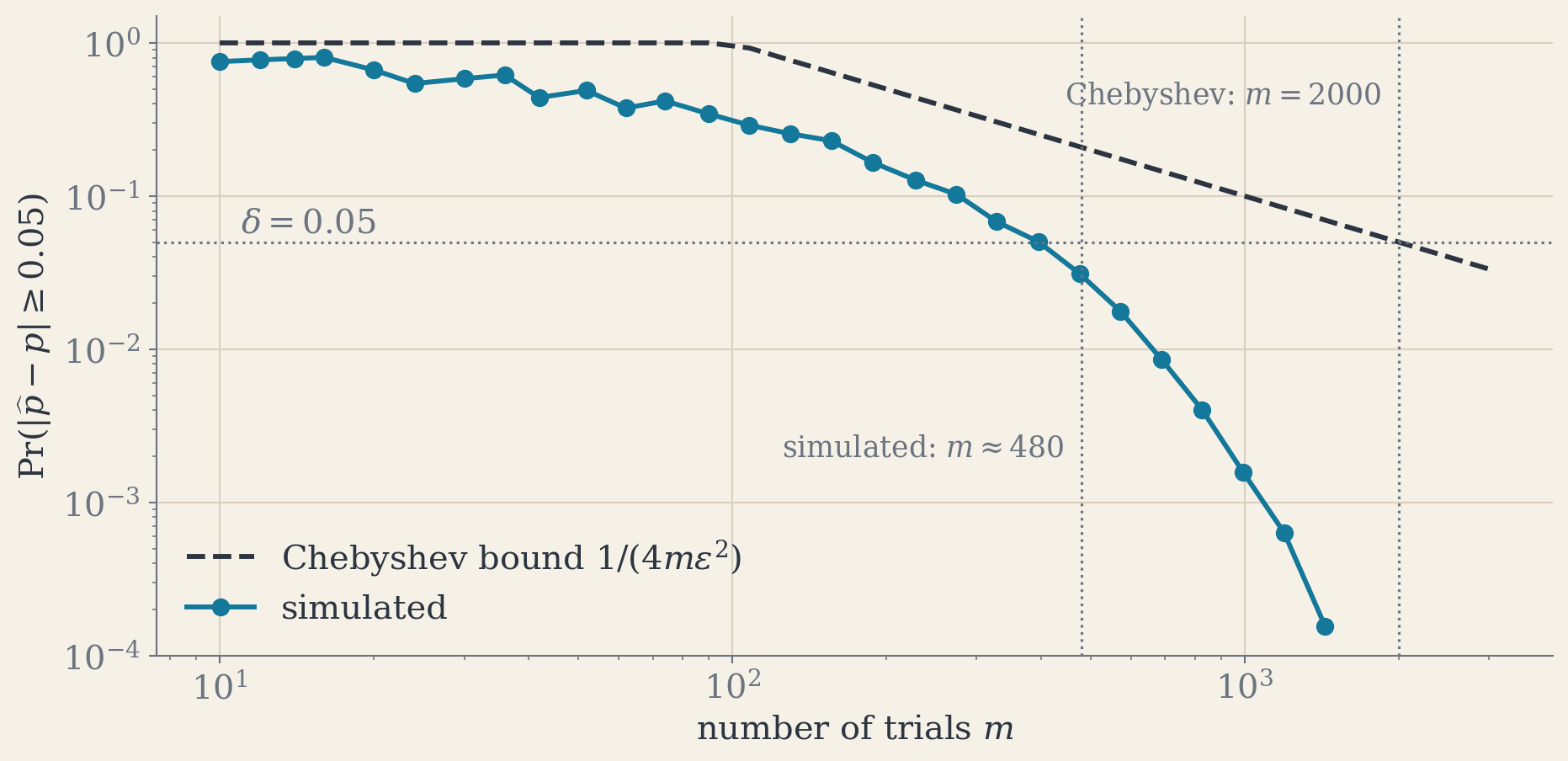
Fraction of 200{,}000 simulated polls with |\widehat p-p|\geq0.05, for p=1/2.
The guarantee holds, but far fewer trials suffice. Chebyshev only uses the variance.
What we can now guarantee
Markov: a nonnegative quantity with a small mean is unlikely to be large.
Chebyshev: a small variance controls deviations from the mean.
For averages, Chebyshev gives
\Pr(\text{error}\geq\varepsilon)\leq\frac{\sigma^2}{m\varepsilon^2}.
Next: what if thousands of estimates must all be accurate?